The False Precision of ROI: Why “Measurable Marketing” Is Quietly Undermining Growth
For the past decade, marketing has been reshaped by one dominant idea: If it can’t be measured, it shouldn’t be funded. On the surface, this […]

Most marketers do not need to become experts in geopolitics.
But we do need to understand what instability does to people, because that always shows up in the market.
When headlines are filled with conflict, economic anxiety, and uncertainty, people do not suddenly stop buying. What they do is become more cautious. They take longer. They question more. They look harder at value. They want proof. They lean toward what feels credible and safe.
That is why moments like this matter to marketers. Not because every brand needs a political opinion, but because these moments change the emotional environment in which decisions get made.
And buying decisions are never as rational as we like to think.
In stable periods, people tend to keep doing what they have done before. They renew the same supplier. Buy the same product. Trust the same process. Much of what looks like loyalty is really habit. It is momentum. It is routine.
That routine is powerful. It keeps markets predictable, but it also makes them hard to disrupt.
Then instability hits.
When the environment changes, buyers start to re-examine decisions they were previously content to leave alone. They ask harder questions. They revisit assumptions. They reassess what matters. They take a second look at value, risk, and trust.
That is the part marketers should pay attention to.
Uncertainty creates caution, yes. But it also creates reconsideration.
And reconsideration creates opportunity.
This is where a lot of marketers get it wrong. They see volatility only as a threat. They assume the answer is to go quiet, cut spend, or push harder on short-term tactics. Sometimes caution is necessary, but the better response is usually more strategic than reactive.
When habits loosen, buyers become more open to alternatives. Not reckless alternatives, better ones. Ones that feel more relevant, more credible, and more useful in the moment.
That is an opening.
For challenger brands, for strong positioning, and for clear value propositions, periods of instability can be some of the few times when buyers are genuinely willing to rethink the default choice.
Of course, that does not mean people suddenly become adventurous. In many cases, they become more risk-averse. But even risk-averse buyers rethink things when the ground shifts beneath them. They may still want safety, but now they are actively deciding what safety looks like.
That changes how marketing works.
When people feel uncertain, their patience gets shorter and their skepticism gets sharper. Their tolerance for fluffy messaging drops fast. Brands that sound vague, overly polished, or disconnected from reality start to feel especially weak.
A lot of marketing only works when people are in a good mood.
That is the vulnerability.
Messages built for stable, optimistic conditions can fall flat when the environment changes. In moments like this, buyers are not just asking, “Do I want this?” They are also asking, “Can I trust this?” “Is this worth it?” and “Is this a safe decision?”
That applies in B2C and B2B.
Business buyers are still human buyers. Behind every budget meeting or procurement process is a person trying to make a good decision without getting burned. In uncertain times, that instinct gets stronger. Buyers want fewer surprises, clearer value, and more confidence that they are making the right call.
That is why volatility tends to reward brands that communicate with clarity and punish those that rely too heavily on style without substance.
The strongest brands in uncertain periods are often not the loudest. They are the ones that make buyers feel understood. They reduce friction. They remove doubt. They make the next step feel easier and safer.
That might mean simplifying your message.
It might mean leading with usefulness instead of cleverness.
It might mean showing more proof and making fewer claims.
It might mean speaking more plainly and sounding more in touch with what your audience is actually dealing with.
This is also why brand and performance should not be treated like opposing strategies in uncertain times. When confidence drops, trust does more of the heavy lifting. Performance still matters, but conversion gets harder when belief gets weaker. Familiarity, credibility, and consistency matter more.
So what should marketers do now?
First, stop assuming your audience feels the same way they did at the beginning of the quarter. They probably do not.
Second, look for where habit is breaking in your category. Where are buyers newly open to rethinking an old choice, an old supplier, or an old assumption? That is often where the opportunity is.
Third, pressure-test your messaging. Is it clear, grounded, and credible? Or does it sound like it was written for a more comfortable market than the one your audience is actually in?
Finally, sharpen your value story. In uncertain periods, the burden of proof rises. Buyers want to know what this does, why it matters, and why they should believe you.
The larger lesson is simple. External instability changes internal decision-making. It changes how people judge risk, how they weigh value, and how quickly they move.
It also disrupts routine.
And when routine breaks, opportunity appears.
Interested in chatting about your marketing situation?
Contact me today at [email protected]

For the past decade, marketing has been reshaped by one dominant idea: If it can’t be measured, it shouldn’t be funded. On the surface, this […]
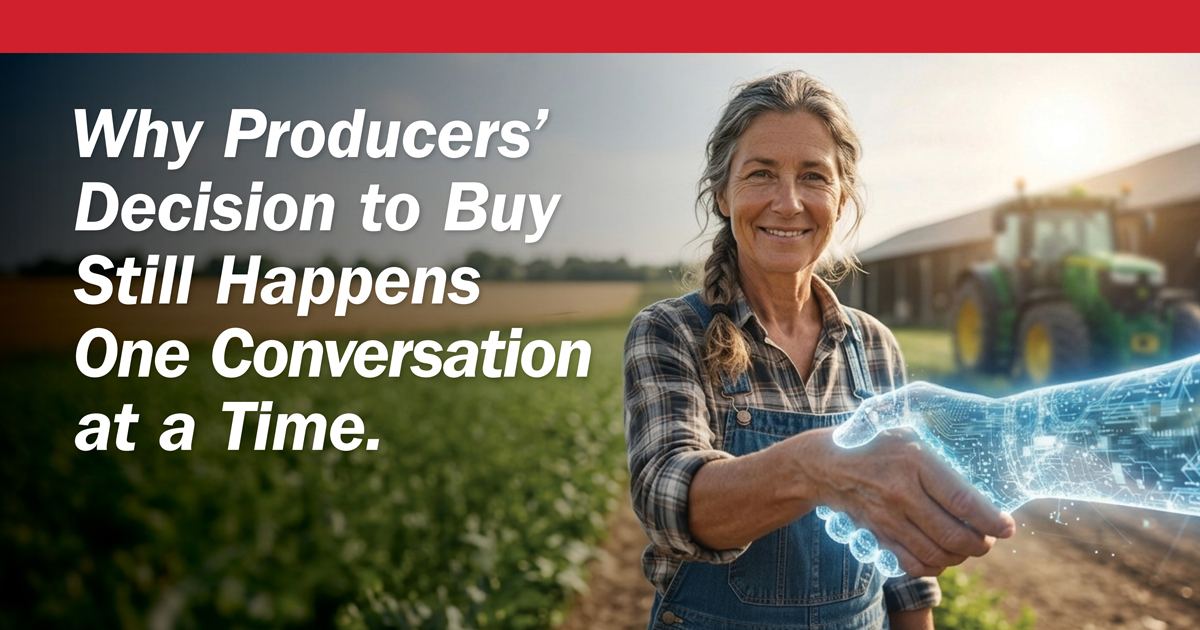
And Why Your “Trusted Expert” Model Needs to Evolve Farmers don’t make decisions because of campaigns. They convert because of conversations. (Campaigns build the funnel; […]
AI is changing business, but not in the way the hype predicted For the last two years, it felt like every conversation in business eventually […]